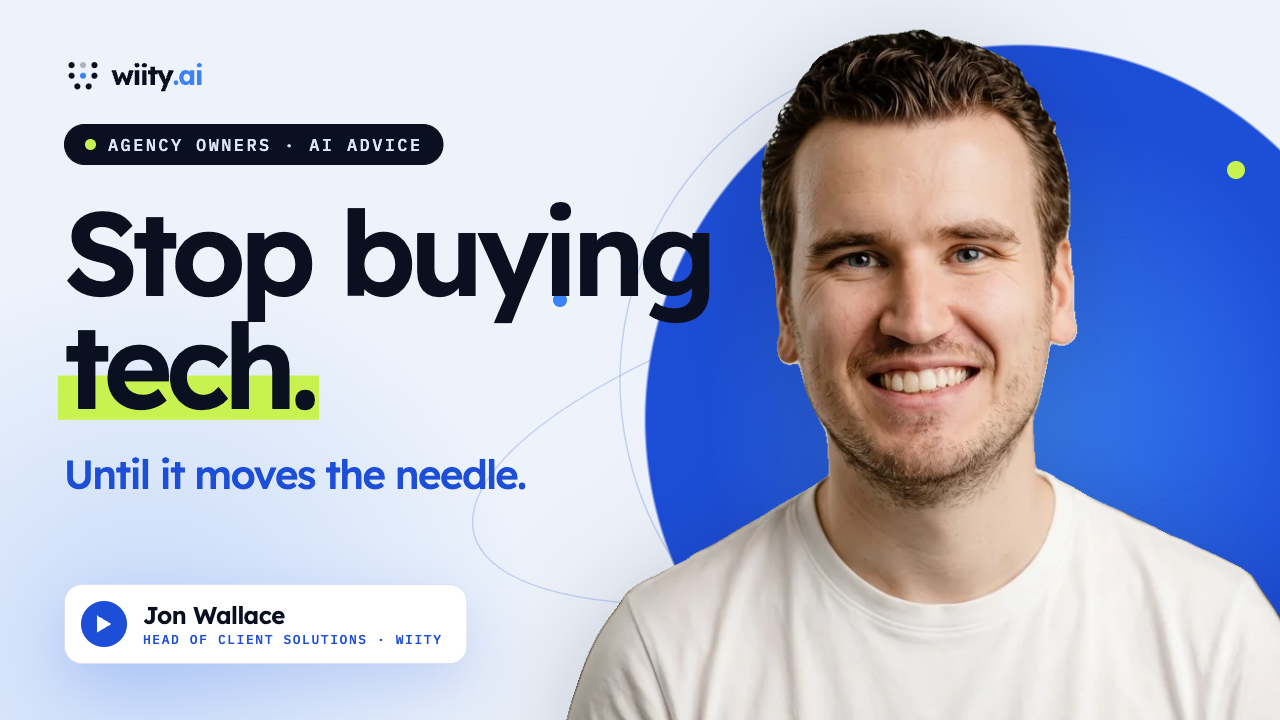
Want to redesign how recruitment businesses run, and see your work in use within weeks instead of sitting in a report?
Recruitment is a people business that has ended up buried in admin. Consultants chase timesheets. Compliance teams chase documents. Finance re-keys the same numbers into five systems. Very little of it needs a person, and all of it takes time away from clients and candidates.
We are changing that, one recruitment agency at a time. This role is at the centre of it.
About Wiity
Wiity is a recruitment AI transformation partner. For decades a recruitment agency could only grow by adding people, and every hire brought more admin. We are breaking that link. Agents carry the chasing, checking and re-keying, and consultants spend their day with clients and candidates.
It is already happening inside Australian recruitment agencies, and we think it becomes the normal way the industry runs. The people who join us now will be the ones who showed it how.
We are a small, founder-funded team with paying clients. Our leadership team has 65+ years between them in recruitment and recruitment technology, including two exits from recruitment SaaS businesses, senior global growth roles and M&A experience in the sector. They know what it takes to build a business like this.
The role
As our Delivery Consultant you will sit with clients, work out how their business actually runs, and design what agents should take on, what simple automation covers and what stays with a person.
You will start alongside one of our founders, then run your own engagements, carrying multiple client projects at different stages at any one time.
This isn't traditional consulting. There are no 80-page process maps and no procedures that are out of date before they are signed off. You will capture, design and prototype with AI from day one, and you will put agents to work on your own job as you go.
What you'll do
- Find the pain. Run workshops, interviews and shadowing sessions to uncover bottlenecks, high-volume manual work and costly delays, from business development and placements through to compliance, onboarding, timesheets and finance.
- Map how it works today. Who does what, which systems they touch, where work changes hands and where decisions get made. Measure it with real timings and volumes, not guesses.
- Trace the data. Follow how data enters, moves and leaves the process, across the ATS, spreadsheets, PDFs and inboxes. Map it to Ella's data model and flag what isn't ready for agents.
- Redesign tomorrow. Decide what an agent handles, what simple automation or rules cover, and what stays with a person.
- Keep humans in the loop. Set the review points, approval thresholds, guardrails and exception paths. A person always signs off a compliance decision.
- Hand it to build, then see it land. Turn the design into requirements and acceptance criteria our engineers can build from. Test it with the client, help their people adopt it, and track the time it gives back.
What you'll bring
Must have
- Three or more years in consulting, business analysis, process improvement or operations, including running workshops yourself.
- A real understanding of how a mid and back office works: compliance, onboarding, timesheets, payroll and invoicing.
- The ability to turn a messy conversation into clear steps, rules and exceptions.
- Comfort with data: you can read a data model, trace a field from system to report, and spot when the numbers don't add up.
- Serious, hands-on use of AI. Show us something you've built, automated or prototyped with Claude, ChatGPT, Gemini or a no-code tool.
Applicants must currently hold full working rights in Australia; visa sponsorship is not available for this role
Nice to have
- Recruitment or staffing experience, and an ATS such as Bullhorn, JobAdder or Vincere.
- Understanding of workforce compliance: Licences, tickets, VEVO, and background checks.
- Experience building agents, Claude skills or automations.
You'll fit here if
- You look at a manual process and can't help imagining what it could be with AI.
- You'd rather show a working prototype than write a document about one.
- You ask “should a person be doing this?” about everything, including your own work.
- You want to own things in a small team where decisions happen in the room, not in a steering pack two weeks later.
- You care about the people on the other side. Automation is about giving people time back, and change only lands when they come with you.
- You're comfortable with ambiguity, and honest when something isn't working.
The details
- Role
- Delivery Consultant, permanent full time
- Reports to
- COO
- Start date
- ASAP
- Location
- Northern Beaches, Sydney. Three days a week in our Manly office once it opens
- Travel
- Client sites, mainly Sydney CBD, sometimes interstate
What we offer
- Profit share, once our company scheme is established
- Up to five days of Bonus Leave a year on top of annual leave, growing with service
- Your birthday off
- Up to a month a year working from anywhere in Australia
- A learning budget and protected learning time
- A paid team volunteer day
- An annual team trip with an AI learning focus, when we beat our targets
- The tools to do the job well, including AI
How to apply: show us, don't tell us
Skip the cover letter. Send us your CV and tell us about one manual process you'd hand to AI, what the AI would do and how it would help you.
For successful shortlisted applicants the first stage of our recruitment process will involve a short call and show and tell with one of the Founders, our COO. We want to see something you have automated, prototyped or agentified with AI for yourself. It does not need to be polished.
Job applications will close on Friday 4th December 2026
Apply for this job
Thank you. Your application is in.
We've received it and a person will read it. If you're shortlisted, we'll be in touch about a short call and show and tell.
Reference: